
“I’m bleeding,” the woman says. It is 5 a.m. in Herat, a province in western Afghanistan, and her call wakes Mahnaz, a 37-year-old midwife. Mahnaz says she’ll meet the woman at the clinic and rouses her husband, who will drive her there. They move quietly as they get ready, trying not to disturb their four sons.
The clinic is a private one, open 24 hours. Mahnaz picks up extra hours there to supplement her regular job at a free clinic run by a nonprofit. Only the very poor go to the free clinics, she says — but it’s not like anyone in Afghanistan feels financially secure these days. “Even the khans have become beggars,” she says. Her patients at the private clinic “borrow money, they sell things,” to pay the fee. “They try to problem-solve.”
Her daily routine shows how dire poverty shapes almost every aspect of life in Afghanistan.
The woman who called this morning is waiting, dressed in black, and they walk together to the treatment room. The day before, the woman visited the clinic saying she’d had a fall, “a story that wasn’t, for me, believable,” Mahnaz says, but she didn’t press for details. Her job isn’t to verify why her patients need care: “Whatever the problem, the pregnancy was lost, and we needed to empty her uterus.” So she carries out a curettage, cleaning the uterus to prevent infection. Once the woman is dressed, Mahnaz explains that she may feel discomfort or pain, and tells her to call if she needs to. It is the woman’s first pregnancy.

This March, Mahnaz documented a typical day, describing her routine to me via WhatsApp voice notes, photos, and phone calls. I’ve been speaking to midwives around Afghanistan to get a picture of what it’s like to provide reproductive health care in a country under Taliban strictures and in a collapsed economy. In some ways, Mahnaz is like a midwife anywhere — handing a newborn to its mother, she says, is the best part of her job. Yet she’s caught between competing norms and rules: new Taliban laws, NGO mandates, and traditional customs. And economic uncertainty: Each year, she waits to see if her contract with the nonprofit will be renewed, given the drastic cuts in international aid to Afghanistan following the Taliban takeover in 2021 and the closure of USAID in 2025. Her daily routine shows how dire poverty shapes almost every aspect of life in Afghanistan; her patients often tell her they literally have nothing, “not even 10 Afghanis.”

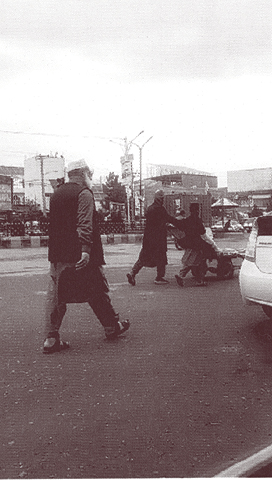
At 8 a.m., Mahnaz leaves the private clinic. With warm, fresh bread in hand, half wrapped in newspaper sheets, she walks to the taxi that waits in its usual spot to take her to her day job at the free clinic, which is at a camp for displaced persons, or IDPs (I’m not specifying the camp or using Mahnaz’s last name to protect her privacy and that of her patients). She sends me pictures: It’s a decades-old blue Corolla, with frayed carpets on the seats and prayer beads hanging from the rearview mirror. Mahnaz gazes out her window as she waits for several colleagues — including a vaccinator, psychologist, and doctor — to join her. It’s gray outside, and light rain earlier left marks on the windows. Mahnaz longs for such weather, preferring it to arid, hot days. Men, women, and children are out, all getting on with their day, all in a rush.
“Everyone’s chasing their own misery, trying to find work, something to eat,” Mahnaz says. In Afghanistan “you work, you try, but you don’t get anywhere … when you see all this, you get so very tired.”
The clinic at the camp was set up as a temporary facility in response to the IDP crisis in Afghanistan — the 3.2 million people displaced from their home provinces as a result of fighting, drought, and other factors, and joined, in the last year, by millions more Afghans expelled by the governments of Iran and Pakistan.
Her first patient is a woman with three small children: one in her arms, two toddlers at her feet. Mahnaz introduces herself and her work. Every appointment follows a similar pattern. She tries to establish trust so women can speak freely. The woman asks for birth control. She is in her forties and has given birth to 12 children. Five of them died young. She is tired. She says she even has a son-in-law — implying that she could have a grandchild any day now — and finds it shameful to be pregnant. Then there are the difficult winters; the family does not have the resources to heat their home.

Mahnaz doesn’t need to hear her patients’ reasons, but she knows they need someone to listen. She laughs and tells jokes. “I want to help them,” she says. “If they bring a child into this world, they will destroy themselves.” She’s met women who are suicidal from the pressure of another pregnancy and another child to support. Women are desperate because they have no economic power. Most don’t work and don’t have their own money.
Family planning is a core service at Mahnaz’s clinic, as it is for many NGO-run facilities: They offer IUDs, the pill, condoms, and injections. But it’s rare to find birth control in any regular pharmacy these days, and doctors are wary of giving out prescriptions for contraceptives, for fear the Taliban will trace it back to them. (In April, Mahnaz updates me that the family planning department at the government hospital in Herat has shut down. For several weeks the hospital hasn’t been giving out contraceptives to patients, because of a new Taliban directive. Her clinic still has supplies, but she’s not sure how long they’ll continue to offer them.)

At the end of her shift at the IDP camp, after one uncomplicated birth and several pregnancy checkups, Mahnaz returns by taxi to the private clinic. Around 6 p.m., a couple comes in requesting an abortion. They were forced to marry by their families, they explain, and they don’t love each other. Neither of them wants the pregnancy.
“They weren’t happy with their circumstances, not at all,” Mahnaz says later that evening when we catch up by phone, but still, she told them no, “it’s illegal.” The law on abortion has not changed under Taliban rule: It is permitted only under exceptional circumstances — for example, when the fetus has a disability or when the mother’s life is at risk. There are laws, and a strong social stigma, against sex outside marriage, which contraceptives and abortion are seen to encourage. Many midwives I spoke with, Mahnaz included, personally oppose abortion in most cases.
Doctors are wary of giving out prescriptions for contraceptives, for fear the Taliban will trace it back to them.
For the doctors and midwives who did perform abortions previously, in private clinics, things have gotten riskier under the Taliban’s crackdown on women and girls’ rights. The Taliban hasn’t specifically targeted people for giving or having abortions, Mahnaz and others say, but the government has punished unmarried couples with jail and public floggings. The few providers willing to offer abortions now charge more for them, according to Mahnaz. Another midwife I ask about abortion tells me that “all my colleagues, as far as I know, avoid this. That’s why most women take steps to end their pregnancies themselves.” An Agence France-Presse investigation last year found that the number of miscarriages in Afghanistan had gone up since 2021, which doctors suspect reflects “clandestine abortions.”
Mahnaz believes abortions have “increased, far more than before … because of hunger and poverty.” Young couples can’t afford children, and they may not be able to afford a wedding. She tells me about something she saw on Instagram, a man joking that it costs 300,000 Afghanis to get married and only 10,000 Afghanis to have sex — i.e., to have an abortion.

Mahnaz says she asked the married couple whether there were any extenuating circumstances — “Where there’s potential for social disgrace — for example, if there is an unmarried woman or girl still living at home … they might be at risk of violence from their father or brother. In those cases, I’ve wanted to help,” she says. But no, the couple repeated that they were married, but they didn’t want to have a child. She tells me she tried to persuade them not to go through with it, and they said, “If you don’t do it, someone else will.”
Mahnaz usually stays at the private clinic until around 7 or 8 p.m., or until there are no patients left. There’s no formal end to it. There’s a room she can sleep in if she has a late delivery.
Tonight, she’s home after 8. She will go straight to bed, no TV, no book. No dinner, either. “I’m on a diet,” she jokes. “If I have patience, I have a shower, otherwise I sleep.” Her family has gotten used to her round-the-clock schedule. Her teenage sons are desperate to leave Afghanistan — some of their friends have, but she sees no safe route out. If she could emigrate legally, she would, as much as serving people motivates her. She’s the breadwinner for the family. If she lost her NGO job, she says, she’d continue at the clinic: “I can’t do any other job.”
This reporting was supported by the International Women’s Media Foundation’s Kim Wall Memorial Fund.
Neggeen Sadid is a freelance writer and reporter living in London.
Video stills courtesy of Mahnaz.
Here's why we publish
Feminist thought is increasingly banned from universities and marginalized in billionaire-owned media. We’re proud to publish it. While these institutions are firing feminists, we’re hiring them — as brave journalists, writers, and artists who challenge ideas about gender at every level.
If this matters to you, please support Lux today. Independent media depends on you.