
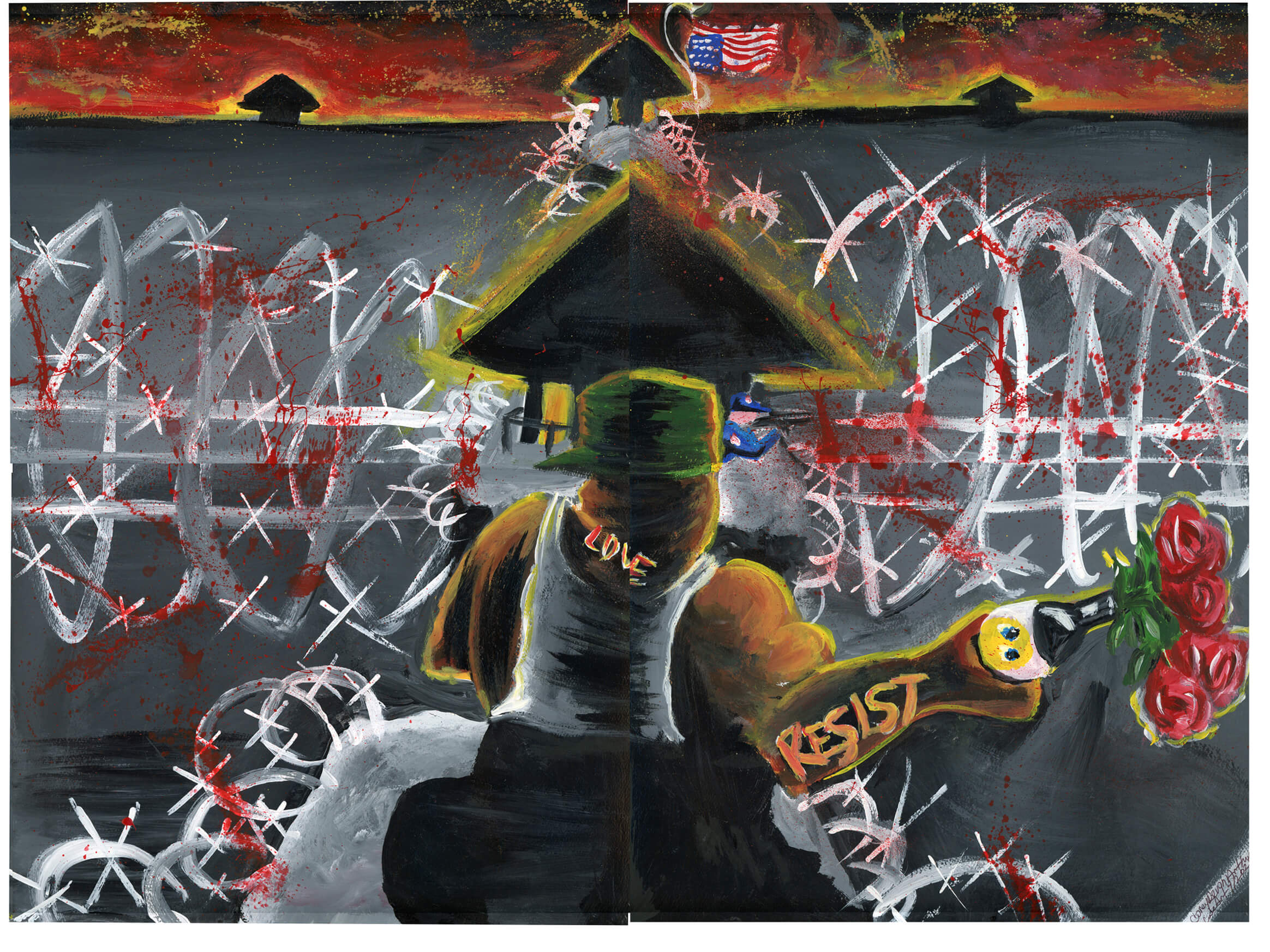
In a cavernous church in Brooklyn Heights in late September last year, while the wealthy neighbors brunched, Writers Against the War on Gaza (WAWOG) held its fifth town hall, cheekily titled School is in Session. One of the main topics of the town hall was what the hell we’re going to do about everyone going to prison. Dozens of activists have been arrested for activities ranging from blocking bridges to screaming at Zionists to defacing private property; for many, the charges could lead to years in prison.
Former political prisoner Jalil Muntaqim, now age 74, is energetic onstage, telling us “to have consistency in doing the work and building a movement.” He talks about returning to the survival programs the Black Panthers pioneered to “build a base, a foundation.” Young activists and wannabe organizers hang on to his every word. Muntaqim, a former Black Panther Party and Black Liberation Army (BLA) member who was convicted of murdering two NYPD officers, was paroled and released in 2020. He’s relatively spry compared to others from his era. Panther 21 defendant Dhoruba Bin Wahad, now 81, was released in 1990 after he filed a lawsuit against the FBI and NYPD for their use of COINTELPRO operations against him. Sundiata Acoli, who was traveling with Assata Shakur on that May evening in 1973, spent 49 years in jail until finally being paroled in 2022 at the age of 85.
Not onstage are any of this generation’s growing cohort of political prisoners. Instead, members of their solidarity committees attend in their place and read statements sent in by text message and lawyers. There’s a representative for Tarek Bazrouk, a Palestinian New Yorker sentenced to 17 months in federal prison for fighting with Zionists at pro-Palestine demonstrations. There’s also a member of the solidarity committee of Jakhi McCray, a 22-year-old charged in July 2025 with setting fire to 11 NYPD vehicles. Jakhi has become highly visible due to a very active solidarity committee and his relative luck in securing house arrest while awaiting trial. From his home in New Jersey, Jakhi has published an open statement on social media condemning the genocide in Gaza and the NYPD’s cooperation with ICE, and he appears sometimes over Signal video calls at events thrown by the Free Jakhi team.
I noticed Laura Whitehorn, the founder of Release Aging People in Prison (RAPP), sitting in the audience, watching the panel — she herself spent 14 years in prison, in part for bombing the United States Senate, among other targets. (She’s now 81, for the record.) When I met Laura, it stretched my mind to meet someone who’d been credibly linked to multiple bombings of state buildings and still got paroled seven years early out of her 20-year bid. In the week leading up to the town hall, activist Casey Goonan was sentenced to nearly 20 years in federal prison for lighting a University of California Police Department patrol car on fire and throwing rocks at an Oakland courthouse, with plans to throw molotov cocktails inside. As I finished writing this story, Jakhi took a plea for his act of arson that will send him to prison for a minimum of five years; he could be sentenced to up to 20 years. A few cars being lit on fire is a far cry from trying to bomb the Senate. I imagine if Laura and her comrades committed those bombings today, they’d be put under the prison.
After the Foreign Intelligence Surveillance Act of 1978 and the Patriot Act of 2001, the surveillance state is stronger than ever. Silicon Valley’s technofascist rise enabled more digital surveillance, rather than individual freedom, as once was predicted in the early days of the internet. In the “free” world, we are all being videotaped at all times by street cameras, private security devices, Ring cameras, and five TikTok influencers with Meta glasses. Our phones are always listening, and maybe even our “smart” TVs and fridges. Some people conspiratorially wondered if they got Luigi through facial recognition on the McDonald’s order kiosk or something (the authorities said they got a tip from a clerk).
the effect of these prosecutions on political activity cannot be overstated.
We’re also facing longer prison sentences than ever. The RICO Act of 1970, supposedly intended to combat Mafia activity, is being used more frequently to repress political activists en masse. Prosecutors are also adding domestic terrorism charges on top of other charges to greatly expand potential sentences and thereby push defendants into taking pleas without trial. Per the U.S. Government Accountability Office, the number of domestic terrorism investigations doubled between 2020 and 2022. In a world where, per the Vera Institute, “researchers estimate more than 90 percent of guilty convictions are the result of plea bargaining,” where prosecutors aggressively negotiate, the RICO Act and domestic terrorism charges are powerful cudgels.
The effect of these actions on political activity cannot be overstated. People are being locked up for minor crimes. In Atlanta, 61 people were indicted in a federal RICO case against Stop Cop City activists, some of whom had done as little as distribute fliers supporting mutual aid efforts. A nonviolent climate protester was sentenced in October 2025 to 18 months in federal prison for spreading water-soluble red and black paint over the glass covering a statue in the National Gallery of Art. In January, a man protesting ICE — which has killed seven people since Trump ordered a ramp-up in deportations — was sentenced to four years in prison for throwing a Molotov cocktail that hit no one.
Jakhi McCray is also a victim of this overreach by prosecutors; the plea deal in which he’ll spend a minimum of five years in federal prison was his best option, considering the threat of domestic terrorism charges that could put him in prison for his entire life. At 22 years old, Jakhi’s life was threatened over a property crime against fewer than a dozen empty cop cars, an estimated $800,000 in damage. The NYPD has a fleet of over 9,000 vehicles, which they’ve undoubtedly used as they committed 11,746 use-of-force incidents in 2024 alone. Those numbers include 14 fatal shootings by officers and 25 deaths in NYPD custody, and over $100 million of taxpayer money in misconduct lawsuits. Very few NYPD officers are ever prosecuted.
“My name is Assata Shakur, and I am a 20th century escaped slave.”
When I think of prisoner solidarity and what it means, I first think of a prison break. And when I think of prison breaks, I think about Assata Shakur, who died as I was starting to write this story. There are few revolutionaries held in the same esteem as Assata, and that’s because she got away. We love Assata because she fought the law; though the state put her behind bars, the will of the people — her comrades — liberated her. The United States government never regained control of Assata’s life or her narrative. The prison break functioned both as a way to save Shakur’s life, and as propaganda of the deed that it’s possible to fight and to win. To me, and to many others I am sure, Assata was a beacon of hope. If she could fight and escape, then so can I.
However, today’s abolitionist movement, a spiritual successor to the Black liberation movement of the 1960s and ’70s, operates in a very different space than Assata did. The Black Panther Party was founded in 1966, the Republic of New Afrika in 1968, and the Weather Underground in 1969. The Young Lords took over Lincoln Hospital in the Bronx in 1970. It’s no coincidence that the era of “mass incarceration” began in the 1970s — we were on their ass for a minute.
To the masters of this world, the prison serves as one of the main deterrents against destabilizing political activity, and as a spot to hold undesirables and surplus underclass populations. Prison as a repressive tool has worked — the movement has largely responded to the imprisonment of a previous generation of militants by ratcheting down confrontational activities in favor of toothless marches. The consequences for political action are higher than ever; people saw what they did to the Panthers and the BLA, and wanted no part of that. Molotoving an empty cop car while protesting police brutality comes at the price Whitehorn paid for bombing the Senate.
It’s no coincidence that the era of “mass incarceration” began in the 1970s — we were on their ass for a minute.
Out of the Floyd protests, amid a brutal, bipartisan-engineered backlash in favor of more funding for the police, a few pathways for the left have emerged. Zohran Mamdani’s mayoral victory in New York excites some with the potential for socialist victory — or, at the very least, a growing constituency, moved by smart and practical city governance, for socialist politics.
In the total opposite direction, a more hard-edged revolutionary abolitionism is asserting itself. This side of the movement is heavily influenced by the Black liberation struggles of the past and the Palestinian resistance and their commitment to freeing their prisoners. In Palestine, the repression of the Israeli state is so severe that nearly everyone knows someone in prison, or has been themselves; incarceration is so central to the occupation that the prison becomes the school of the Palestinian resistance. A Yemeni friend recently back from the West Bank told me a joke an older Popular Front for the Liberation of Palestine member would make, always with a laugh and a warm pat to the knee: “Ya rafiqi, mataa hatistashhad?” — Comrade, and when will you be martyred? The humor with which Palestinians approach the dark inevitabilities can be shocking and joyful. In fact, most of the recent political prisoners that have a public profile are locked up on charges relating to solidarity actions with Palestine.
Lounging on a couch at Another World Movement Center, a community space I cofounded earlier this year in Crown Heights, Brooklyn, I spoke with organizer Mansa from the revolutionary Black group For Our Liberation about what Assata meant to us. He says he’s worried we’ve failed Assata, that we haven’t heeded her lessons. I ask what lessons he thinks she’s given us.
“Commitment. Discipline. Some sacrifice. Love, of course, love.”
“What does love compel us to do?” I ask.
“It compels me to sacrifice everything that I am.”
I love him for saying it, but we both know it’s naive to believe that such sacrifices can be made in a vacuum.
The year 2020 was a glimpse of what it might be to get free, but more importantly of what conditions might lead people to make sacrifices and take risks. Though it increasingly seems like a fever dream, millions of people took to the streets in protest against police brutality, and thousands were willing to escalate protest into riot. Many of us vividly remember the encampments across different cities where hopeful masses advanced into the mainstream theories of police abolition, practices of mutual aid, and dreams of a new way of living.
I was in the NYC streets with my first abolitionist collective and became active in a doomed yet energetic Defund campaign. I remember moments that feel almost forgotten six years on. Beyond the heady looting of SoHo and physical brawls with the NYPD in front of Barclays, I saw and participated in a variety of risky actions that were revolutionary in their potential to change the material relationships we have to land and state. Before the eviction moratorium in late 2020, I attended multiple eviction defenses in which we used our bodies to assert the right of people to live in their homes, fighting landlords’ agents at the doors and on the sidewalks. It was against the backdrop of these successful defenses that New York State’s eviction moratorium was passed, both to protect tenants and to save landlords from the rising revolt.
We should ask ourselves: Why were these actions successful? Undoubtedly this was because the police simply could not keep up with the number of actions happening, and even more so, because people felt protected by the fierce solidarity that was being shown. When you know support is around the corner, you’re not afraid to fight back.
In 2026, most people have returned to the status quo of going to work and paying rent. The kind of solidarity and support that felt so immediately present in our lives in 2020 feels much more distant, and consequently so do the possibilities for action. But action does happen, and so does solidarity. Prisoner solidarity committees are oriented toward creating supportive communities for the person inside and are almost always explicitly focused on legal methods of support. The person inside is usually heavily involved in their own committee’s activities, and the committees focus on a single person.
On a cold Friday in November, dozens of people in Brooklyn are listening to the chaotic melodies of the prison over a Zoom call connecting Rev. Joy Powell and supporters from across the country. Rev. Joy is incarcerated at Bedford Hills, the only maximum security women’s prison in New York. She’s been incarcerated since 2006, on shockingly thin evidence and under politically suspicious circumstances, for burglary and assault. Her prisoner support committee put this event on to show Rev. Joy that she’s not alone, that we do not believe the state’s stories about her, and to raise a bit of money for her books.
On screen, a speaker from the Jericho Movement, a national political prisoner solidarity organization, says that although Rev. Joy is currently the only prisoner they support in New York, they anticipate this changing quite soon. The acknowledgment of the rapidly growing ranks of new-era political prisoners sends a chill over the room. For some, whose faces I have seen in the streets and whose real names I do not know, the possibility of becoming one such person on the inside is more real than for others.
The fundraiser takes place at Another World. This event — with its speeches over Zoom from Rev. Joy and supporters, a performance by a local rapper, and a screen printing craft table — isn’t flashy, but people show up excited to participate. Events like these show what it looks like to build an inside-outside movement.
“Everything costs money inside, and there’s never enough to support them — whether they’re inside or whether they’re getting out.” Allison, one of the lead organizers, is gently encouraging the crowd to donate money. Fundraising to support someone inside keeps them well fed and taken care of in ways that prisons do not allow for free, and it is one of the hallmark activities of these prisoner support committees.
The other key activity is letter writing, which has the benefit of providing moral support to the person inside while also being free and easy to do. Every solidarity committee event I’ve been to has included a letter writing portion; for people awaiting trial, receiving a large bundle of letters may be the difference between feeling all alone and feeling supported. Letter writing is also used for building relationships with nonpolitical prisoners. When Jaia Cruz, a trans woman in NYC who stabbed a man in a deli, was sentenced to 15 years in prison, trans organization Arm the Dollz arranged a letter writing day. Jaia is not a political prisoner by traditional definition, but her case was quickly politicized by trans activists, who say her actions were taken in self-defense under transphobic conditions. By entering this relationship via letters, Jaia becomes part of the political movement against policing that disproportionately targets people like her.
Let us become known to each other.
Jail support is another common abolitionist solidarity activity. Jail support used to refer mostly to the solidarity and care rendered to fellow actionists in the aftermath of protest arrests. Recently Brooklyn Jail Support and its sister spin-offs, Manhattan Jail Support and Bronx Jail Support, have pioneered new forms of support for working-class people making contact with the carceral system. Their weekly tabling and political education apparatus aims to make community with any person walking out of the jail and courthouse directly across the street from their operation, and with any person passing by. The table of hot food, drinks, clean socks and underwear, and hand warmers attracts a steady stream of curious and grateful lumpenproletariat, those people who are often otherwise treated as social outcasts in the ever-gentrifying gleaming new Downtown Brooklyn.
These existing prisoner solidarity efforts are necessary but not sufficient practices for the abolitionist left, and they’re not without pitfalls. The work of a solidarity committee can be overwhelming and emotional, and people on the outside who are heavily involved in one committee are typically not involved in any others. This means that each solidarity committee is sort of its own world, though of course the committees are well aware of one another and interface with larger organizations like the Jericho Movement, which can unite prisoners under the umbrella of solidarity.
The deep-seated paranoia around organization stemming from COINTELPRO and the surveillance state can also sometimes mean a rejection of efforts to bring together different committees and formations doing solidarity work. In the aftermath of losing their case, Casey Goonan and organizers from a semi-anonymous political education collective, Workshops 4 Gaza, fell out with one another in a messy fight. Goonan and supporter/former political prisoner Eric King began circulating statements accusing, by name, some supporters of the Free Casey campaign of “dangerous behavior.” Among a list of other crimes, Goonan accused them of “trying to accumulate as many support teams as possible to build a ‘national network.’”
Inside other organizations like Survived & Punished (S&P), which focuses on supporting criminalized survivors of abuse, problems have arisen when the monetary support that outside members can offer to inside members has dwindled. A comrade from my first abolitionist collective who joined S&P said that while material support is critical to those inside, when it is the primary interaction between inside and outside members, trust can be lost quickly. The hard-won relationships between the inside and outside, and among various solidarity campaigns, are often fragile.
A slightly more militant role that committees can play is building movement support through politicizing the acts that landed people in prison or by making the political nature of prison more legible to the public. In a bygone era, this sort of support looked like an open letter or an op-ed in a newspaper. Today, it often looks like an Instagram multi-slide grid post, sometimes disseminated via repost through a network of loosely connected abolitionist or anarchist groups. These posts are often the only mechanism abolitionists have to get information out about cases and to present an alternative understanding of what prison is.
While abolitionists have made great progress in renewing a prisoner solidarity movement post-2020, the biggest challenge is that prison has become a place where political action is nearly impossible. We treat prison as a black box that we focus all our energy on keeping people out of, and once they’re in, we’re focused on the appeal process, the act of getting them released.
This is not to valorize prison or denigrate the efforts we put into keeping and getting people out — these things are critical and must always be pursued. However, to accept that prison is a black hole that swallows up a person’s ability to act politically is to accept the terms of the prison system. In our conversation about Assata’s lessons, Mansa, a self-taught historian of the BLA, tells me about how it was once just a loose term for underground cells that barely interacted with each other in formal ways. It wasn’t until 1974, when multiple Panthers were in prison, that the BLA formed a central organizing committee. The prison was a container that helped the BLA develop.
On Pacific Street in Brooklyn, outside a building owned by the Pinnacle Group, tenants are gathered for a rally to demand that their landlord pay overdue lighting and heat bills and make repairs. This is the first rally of a new campaign to unite tenants from almost 40 buildings across New York that are owned by billionaire Joel Wiener and Pinnacle, and that are now facing an uncertain future after Pinnacle’s Chapter 11 bankruptcy filing. Tenants and supporters are spilling off the sidewalk into the street, and marshals like me are watching the traffic and looking out for cops and Zionist agitators (the Pinnacle campaign has highlighted how Wiener tapped the Israeli bond market for financing).
Two young Black teens walk past the crowd, scoffing. When I meet their gaze, they ask what this is all about. They’ve never heard of a rent strike before, and they don’t know anything about tenant organizing, but they agree that getting charged rent when everything is broken and dusty and run-down is bullshit. But — and they say this conspiratorally — what can even be done about it? What, are we going to fight the law?
It’s September and Assata has just passed. I mention her. They don’t know her, but they know the name Shakur — Tupac. I find my way in through the family connection. They are intrigued. In ten minutes, I get to the root of it: This country has always enslaved us and we must get free, and that freedom won’t be handed over unless we force them. The landlords, the cops, and all manner of bigots are in cahoots to extract all value from us and to keep the boot on our Black necks specifically. The boys pick up what I’m putting down immediately. They say they’d join up in my people’s army right now, except: “What are these white people even gonna do?”
The abolitionist movement today is a multiracial movement, but its roots are in a Black radical tradition that includes an orientation toward survival and resistance rooted in an inescapable Othering from whiteness that I’m not sure white comrades always understand. I think about Dhoruba Bin Wahad’s 1977 letter in which he takes offense at the notion that Assata is a feminist or anti-capitalist before she is a Black revolutionary, emphasis on black.
There are some white ‘leftists’ who would support Assata because she is a revolutionary and opposed to the capitalist ruling classes and their flunkies in black face. These individuals and groups proceed from the premise that black peoples struggle is merely one of class and that the virulent racism of U.S. society can be effectively combated with some social democratic idela [ideal] of white and black worker solidarity. White Workers and Black Workers Unite they scream — solidarity at all costs they rave, not understanding that they are screaming in the face of history and hundreds of years of domestic neo-colonialism and racism … Support of Assata is support of our right to national self-determination and the struggle to acquire that right.
Bin Wahad’s letter was written before Assata was even convicted, and in his framing of her actions, he does not bother to affirm her innocence (which she maintained). If she did it, she was justified, he says. Action against the colonial state by Black revolutionaries is an expression of the ongoing struggle for self-determination, which began when Black people were enslaved and taken to the Americas. Has this enslavement ended? Consider that more Black people are in U.S. prisons today than were enslaved in 1850.
In the post-2020 and post-Mamdani political landscape, many on the left are trying to fight within the law for housing, for child care, for transit, for better wages and nicer living conditions. If this is the fight, then perhaps the prison can be left in place. In fact, Mamdani has dropped in a heartbeat his previous commitments to defund and no new jails, keeping on previous Mayor Eric Adams’ police commissioner, Jessica Tisch. Among some “sensible” social democrats, this is okay, because policing and prisons are side issues to the real meat and potatoes of housing, child care, and transit. Commissioner Tisch does not seem to intend to let policing be a side issue; the notoriously brutal anti-protest Strategic Response Group has been deployed multiple times under Tisch’s command despite Zohran’s public demand that it be disbanded. The NYPD has made a point to violently arrest city council member and close Zohran ally Chi Ossé not even six months into Zohran’s tenure (notably, during an eviction defense). Zohran has capitulated to the police in many ways, but they’re still trying to ruin him. Time will tell how effective the NYPD will be at this, but if their history of intimidating mayors is anything to go by (see: the 1992 police riot against the first Black mayor), it’s not looking too hot.
This is a vital issue because Black freedom has always been outside the law in a nation built on our enslavement. The logic suggests, too, that white people who seek freedom and comradeship must understand that they are working against whiteness; you must become, like me, blackened, outside the law. Black people, and all other people who become discarded by the state and become in essence blackened by it, can’t find freedom in this world so long as the prison stands.
So it is not just a fight for housing, for child care, for transit, for better wages and nicer living conditions. It is about the practice of self-determination. The Pinnacle tenants have attempted to use the law to force their slumlord to not sell their building to another potential slumlord, and to do repairs. As of early 2026, this effort has failed even with the support of Mayor Mamdani. Fighting for collective control under the law can only take these tenants so far — increasingly they are turning to occupying the buildings rent-free, and using their collective powers to address their issues and defend their territory.
You must become, like me, blackened, outside the law.
They are not the only ones. A similar defense at 212 Jefferson Avenue in Brooklyn is currently underway, and it is the primary tactic that has kept the people who live there in place despite deed theft that grants new owners the “legal” right to kick them out. The rightful owners, who are Black, were divested of their rights to their home through dubious but “legal” means; they intend to keep their home through the law of the people, not the state. The same tactic of occupying space against law has kept dozens of other people in their homes across Brooklyn; cases like 964 Park Place in Crown Heights, where the eviction defense was supported by both the Crown Heights Tenant Union and Brooklyn Eviction Defense, became especially visible after the expiration of the pandemic-era eviction moratorium. I think it is no coincidence that some of the most militant actions we see still being taken right now are eviction defenses by Black homeowners, who feel a sense of ownership over their property and therefore are willing to defend it. Carmella Charrington, the matriarch of 212 Jefferson, spent six days in Rikers for her defiance of the law.
The demand for free transit in New York City may possibly be met within the law by Mamdani’s promise to create free buses, but already there are signs it may stall out unless he becomes more willing to piss off the governor and is able negotiate new policy within an MTA partially owned by New York State. But New Yorkers take these matters into their own hands every day, by holding the doors to the subway open and breaking the city’s new fare-evasion gates with bike locks. Even in the American city with the largest police force, the cops simply cannot stop all of us. The same principle applies to all illegal actions that people take to live good lives, ones in which we stay in our homes and access food that is too expensive on poverty wages and use public infrastructure built off our stolen labor: They can’t catch us all.
What happens once we’re inside? Political action can take place when we expand the definition of political prisoners and build bridges between those who are incarcerated for “political” crimes and those inside for other activities. The carceral system has divided natural allies within the prison, turning a would-be class into a collection of individuals vying for special privileges given out to the obedient and docile.
Orisanmi Burton writes in his book Tip of the Spear about what he calls the “Long Attica Revolt,” the series of uprisings that took place in New York State prisons in the 1970s. He makes the case that prison is a potential site of disaster for the oppressor — everyone in there hates him! In an interview with the New York War Crimes, a newspaper produced by WAWOG to serve the struggle for Palestinian liberation, Burton describes prison reforms undertaken after the rebellions:
Prison reforms were doled out in unequal ways, and … in certain prisons, some people were given more punishments or privileges than others. This structure overall was designed to encourage people in the really brutal prisons to behave themselves with the hope of one day moving to a nicer one, and vice versa, to encourage people who were in the nicer prisons to stay in line or else be sent somewhere worse. So it’s a tiered structure which discourages everyone from thinking about the collective and encourages people to think more in terms of their own personal investment.
Prisoners who are inside for political activity are not only abused by prison officials, they are also elevated as particularly worthy by allies on the outside. But what in the end is the difference between a political prisoner and a so-called criminal? The conditions that drive both into prison are often the same. As George Jackson asked, “Did I colonize, kidnap, make war on myself, destroy my own institutions, enslave myself, use myself, and neglect myself, steal my identity and then, being reduced to nothing, invent a competitive economy knowing that I cannot compete?”
To help all prisoners ask and answer this question and render themselves as a class with interests that can be collectively fought for, imprisoned revolutionaries create political education. There are efforts like Stevie Wilson’s Dreaming Freedom Practicing Abolition network of study groups. The network was sustained by a WordPress blog listing current study groups and blog posts from Stevie, who was locked up in Pennsylvania, as well as by his Twitter. Stevie, a queer Black organizer, has maintained this network since at least 2019, with the help of people inside and out, including the widely respected abolitionist organizer Mariame Kaba. This study has been hampered by the almost control prisons have over reading material, but despite the constant censorship, without a total ban on books and media, it cannot be totally stopped. So long as there is mail, so long as there are books, so long as there is communication, networks of study can be born and grown inside the prison.
These study groups have reverberations that carry through to the outside. Stanley “Jamel” Bellamy from RAPP is a prime example of this. He tells me he only became political when an oldhead in Attica forced him into a study group, which he was not too enthused about at the time. But relational networks are the highest currency one has in prison, and he attended out of respect. This changed his life. Released in 2023, Bellamy is now an organizer in Brooklyn with years of experience under his belt as an organizer inside. He’s a far more effective speaker and consistent communicator than most other organizers I know, things he learned to be out of necessity. He tells me I need to answer my text messages in a more timely fashion (he’s right). He writes down every appointment immediately and he sends a follow-up soon after each meeting. The basic thing, inside and outside prison, is the one-on-one meeting and the ability to follow through and keep up with your connections.
Prison publications are also a potent form of political education within the walls. In the Belly, a journal produced by a team of incarcerated and outside editors alike, is distributed for free to other prisoners. Their stated mission is to “strengthen the bonds between all of us to overcome the state’s regime of isolation.” Essays cover the origins of Black August and personally narrated reports of conditions inside. On the magazine’s Instagram page, they post fundraisers for people’s medical care inside and infographics about creating secure burner phones. While publications like In the Belly remain small and limited in distribution, every copy that makes it inside a prison has the potential to touch dozens of hands, even if there is only one official subscriber.
People inside are not limited to publishing only in prison-focused publications. With the help of outside organizations like Empowerment Avenue, and left publications such as this one, incarcerated people can become movement writers read by a wide audience. Kwaneta Harris, currently incarcerated in Texas, became a politicized prisoner through her experience trying to share abortion information with other women held in solitary, shouting through the bars. She wrote about her experience in Lux, as well as in other publications. Her writing over the years has expanded beyond just her experiences — now she writes critical reports about the conditions of the prison.
He tells me he only became political when an oldhead in Attica forced him into a study group.
A politicized prisoner can also easily make another one — the conditions of the prison can be highly conducive to seeding a deep rage at the system if it’s not already present. This type of organizing is relational, with trust built through the sharing of resources, which can lead to the sharing of knowledge. Rev. Joy Powell uses the money on her books to buy food for other prisoners, which has made her a powerful presence inside, and a sort of house mother that combines everyone’s commissary so that they can make a large family dinner. At her fundraiser she described stopping guards from intimidating an incarcerated woman by threatening to use her network of supporters to draw attention to their abuses.
Activist Calla Walsh faced up to 37 years in federal prison after vandalizing an Elbit Systems building with other Palestine Action U.S. members in 2023; ultimately she took a plea deal and spent 40 days in jail. She struggled not with the time in jail, but with the way “people in the movement and more broadly look at incarceration as a form of social death.” Despite this feeling of having disappeared, Calla also described her short time locked up as an opportunity to connect with people who were eager to understand what was happening to them. When she received books, she shared them with other prisoners. “There was also a poem by Assata called ‘What Is Left’ that she wrote during her incarceration. I had someone send it to me over the jail tablet and I transcribed and made copies of it and shared it around with people. Everyone wanted a copy.” Prison became the next site of Calla’s political activity instead of its end.
I’d be remiss to not mention that this type of organizing comes with the risk of retaliation. Kwaneta was even further isolated from other prisoners in the solitary block after she attempted to disseminate sexual health information by speaking through the vents. Stevie Wilson wrote in The Abolitionist about his February 2025 parole denial: “As soon as I sat down, I was accused of being part of a security threat group (STG) — a gang. I was told my institutional record said I belonged to an STG, namely ‘the abolitionists.’” As of February 2026, Stevie continues his work from the outside; he maxed out his 15-year sentence without ever achieving parole. He survived the prison, and has returned to the outside world with a stronger political network than when he went inside.
When I think of Assata, I think of her comrades.
She only spent two years in prison before she was liberated by fellow members of the BLA in 1979. The next few years were spent on the run before she finally arrived in Cuba, where she received asylum from Castro and was able to reunite with her daughter. In an open letter from 2013, the same year the FBI put her on its “Most Wanted” terrorist list with a $1 million reward for information leading to arrest, she called the island “One of the Largest, Most Resistant and Most Courageous Palenques (Maroon Camps) That Has Ever Existed on the Face of This Planet.” She lived there for the rest of her life.
What did this cost? Four comrades — Mutulu Shakur, Silvia Baraldini, Sekou Odinga, and Marilyn Buck — were convicted of some part in aiding her escape. They paid heavily. Mutulu Shakur and Marilyn Buck were sentenced to 60 and 80 years, respectively, and both died within months of their parole releases. Sekou Odinga was, in comparison, lucky. He was released from prison in 2014 and died in 2024 — ten good years outside again. Baraldini, an Italian citizen, served 17 years in an American prison until the U.S. finally relented to Italy’s repeated requests for her transfer. She was pardoned in Italy in 2006, after suffering from breast cancer and in prison conditions that she publicly spoke of as worse than American prison.
When I think of Assata, I think about a story Jalil Muntaqim told at the WAWOG town hall. He and some comrades were sitting around, bullshitting. They considered a hypothetical: What if they were locked up and the only way out was to eat a bowl of shit? He said most of them tried to consider ways to fake-eat the shit, some method of maneuvering around the obstacle. The comrades posed the hypothetical to Assata. Jalil laughed when he told us her answer:
“Well, where’s the spoon?”
When I think of Jakhi, I think he’s picked up the spoon too. And like Assata, he isn’t alone. People have stepped up to support him through the legal battle and now, after his plea, through the experience of going inside, so that he can continue to be part of the movement. On video at a poetry night, Jakhi laughs as he reads to the crowd. Before his arrest, many people in the room did not know him, including me. The repression, while unwelcome, is counterbalanced by the community being built in real time around him. He is more part of the movement than ever, and so are all of us coming out in support. More people will take action in a variety of ways because they are inspired by his actions, and because they see that going away is not the end.
Calla, who was prepared to go to prison potentially for years, says, “Treating us like martyrs or victims or people who are doing this inhuman, intangible thing only serves to make what we did more intangible, when what we want people to realize is far more people can go to jail and survive that experience than they realize.”
In anticipation of what will come, we need the containers in which to develop true love for each other, including physical spaces that act as anti-prisons and build up relationships that will persist through criminalization. The prison with its walls becomes an impenetrable fortress against a movement of ideas — let us take space, share freely, and become known to each other. Our choices for liberation are increasingly limited, and everything that would be effective is illegal. In his missive to the WAWOG town hall, Jakhi emphasized, “We must always remember that the maximum solidarity is equal risk and equal action.” We must endeavor to get away, but we must also accept that some of us will be caught.
And what then?
Cheryl Rivera is an editor at Lux. She is cofounder of Another World, a community space in Crown Heights.
Here's why we publish
Feminist thought is increasingly banned from universities and marginalized in billionaire-owned media. We’re proud to publish it. While these institutions are firing feminists, we’re hiring them — as brave journalists, writers, and artists who challenge ideas about gender at every level.
If this matters to you, please support Lux today. Independent media depends on you.