
My preferred definition of lesbianism belongs to Divine. In Pink Flamingos, a reporter from the Tattler asks Divine whether she’s a lesbian and she answers, “Yes! I have done everything!”
If you aren’t a lesbian, your understanding of lesbianism might be apophatic. In layman’s terms, that means you understand it by what it is not: A lesbian is someone who is not attracted to men. Apophasis has historically been reserved for the divine (lower case), the essence of God presumed to be beyond human comprehension. While this may seem flattering to lesbians, those of us actually in the life tend toward self-fashioning that’s less negative and more maximalist. It isn’t even enough to explain that a lesbian is a woman who loves women, because then we’d have to ask: What, exactly, is a woman?
This was Monique Wittig’s question in her 1980 essay “The Straight Mind,” in which she found her way back to a different apophatic definition for the lesbian:
What is woman? Panic, general alarm for an active defense. Frankly, it is a problem that the lesbians do not have because of a change of perspective, and it would be incorrect to say that lesbians associate, make love, live with women, for “woman” has meaning only in heterosexual systems of thought and heterosexual economic systems. Lesbians are not women.
Wittig is more interested in lesbianism as a strategy than as an identity to rally around, as something one does rather than something one is, mostly because, for her, categories exist under a symbolic order mandated by heterosexuality. In fact, she argues that lesbians should “disidentify” with the category of woman because it exists as a naturalized structure that folds an otherwise marginalized class into normative privileges. Apologies to those who kvell over the mythic potential of écriture féminine — Wittig is uninterested in the biological essentialism of her contemporary Hélène Cixous, who urges women to write with “that good mother’s milk,” a.k.a. “white ink” (unless we’re talking about cum or, as Wittig calls it, “cyprine”). Wittig therefore calls for detaching lesbian identity not merely from the gender binary, but from gender itself — a gesture familiar to all the freaks across the rainbow.
If, historically, lesbians have been shunned from feminist organizing groups and elbowed out of gay-dominated political groups, if our bars vanish, if we fight for everyone else’s rights and no one else fights for ours, if we only get to go first in the acronym thanks to our care for gay men during the AIDS crisis, and if it is assumed that we cared for gay men during the AIDS crisis not because of our experience being left out of the system but because as women we are natural caretakers, then it is understandable that some of us might cling to everything we have — even a category that would prefer not to have us anyway. The category of woman is useful when we are talking about material disadvantages, like the restriction of bodily autonomy or pennies to the dollar or the likelihood of our getting abused at home. But as Emma Heaney explains in Feminism Against Cisness, “cisness obfuscates the reality women with the fiction woman.” Wittig’s materialist critique was to dispose of this “myth of woman,” or of the assumptions about women’s “natural” and “biological” difference, assumptions that feminists of her time (and ours) espoused. As Paul B. Preciado claims in his introduction to The Lesbian Body, Wittig’s novel should be read today because it is “more useful than ever in countering naturalizing and normative conservative feminist entitlements.” Even more so than her theory, Wittig’s novel, unbound by the demands of argument, shows how capacious, expansive, messy — and even constructed — lesbianism is.
Monique Wittig was a French writer and activist, first known for her novels The Opoponax (1964) and Les Guérillères (1969). In 1970, she was one of the women who laid a wreath at the Arc de Triomphe in honor of the wife of the Unknown Soldier; this group would go on to form the French Women’s Liberation Movement (MLF). ProtoTERFism got the better of the MLF as the straight members, predictably, wanted to equate “female” bodies with maternal ones. Wittig broke from the group with other “materialist feminists” who understood “women” to be a class construct existing under a heterosexual social contract. Together they formed the first autonomous lesbian movement, the Gouines Rouges (Red Dykes). Wittig later left France for the United States, where she completed her PhD, wrote more political fiction and nonfiction, and cowrote Lesbian Peoples: Material for a Dictionary (1979) with her lover, Sande Zeig. Although much of her work has fallen out of print, the small press Winter Editions recently reissued The Lesbian Body (1973) and her final novel, Across the Acheron (1985); Verso is publishing her revised doctoral dissertation and some unfinished material as The Literary Workshop.
Reading this book is hot and exhausting, like lesbian sex.
The Lesbian Body is meant to be read one-handed. As Preciado warns, “This is not bell hooks’ on love. Nor is it Andrea Dworkin bitching off and venting out her probably justified and well-informed centurial anger about straight men.” If you want a break from relitigating problematic ’70s feminists, then rest easy here. Note that The Lesbian Body is a sexually violent book, because to write a passion that has never before been spoken (according to Wittig) necessitates violence. Le Corps(e) lesbien: the pun works in French. The book reads closer to prose poetry than to a novel, each paragraph appearing as a long block of justified text with blank spaces between. A selection:
…
Ispill m/yself into you, you mingle with m/e m/y mouth fastened on your mouth your neck squeezed by m/y arms,Ifeel our intestines uncoiling gliding among themselves, the sky darkens suddenly, it contains orange gleams, the outflow of the mingled blood is not perceptible, the most severe shuddering affects you affects m/e both together, collapsing you cry out,Ilove you m/y dying one, your emergent head is for m/e most adorable and most fatal, the sand touches your cheeks, m/y mouth is filled.
Wittig’s language performs rather than describes the erotic depths the speaker and addressees explore together. What do I mean by “performs”? I mean that reading this book is hot and exhausting, like lesbian sex! I also mean something very literal: For those who do not know what it is that two women can do together, for those to whom this arrangement is unimaginable, The Lesbian Body rips them a new one. “There is not one who is unaware of what takes place here, which has no name as yet,” Wittig writes on the first page, ready to begin naming, “let them seek it if they are determined to do so.” Every erotic act is a physical and spiritual transformation. One is not born but rather becomes a lesbian, to steal from an author who, unfortunately, stopped becoming a lesbian. In fact, to be a lesbian is always to become a lesbian, to become and become and become again. (A lot of becoming. Pace yourself and stay hydrated.)
A language as strictly gendered as French (the word for body is masculine) cannot help but commit a certain violence against its speaker, and so she writes “I” and “m/y” with a strikethrough (“j/e” in French). In French, the strikethrough splits up the subject, suggesting an excessiveness to the self, though in English the crossed out “I” also reads as self-negating. (Apropos: Wittig’s English translator, David Le Vay, was a surgeon and the author of Teach Yourself Human Anatomy and Physiology.) There is an “I” and a “you,” but one must not assume characterological coherence here. There are infinite “radiant ones” in this text.
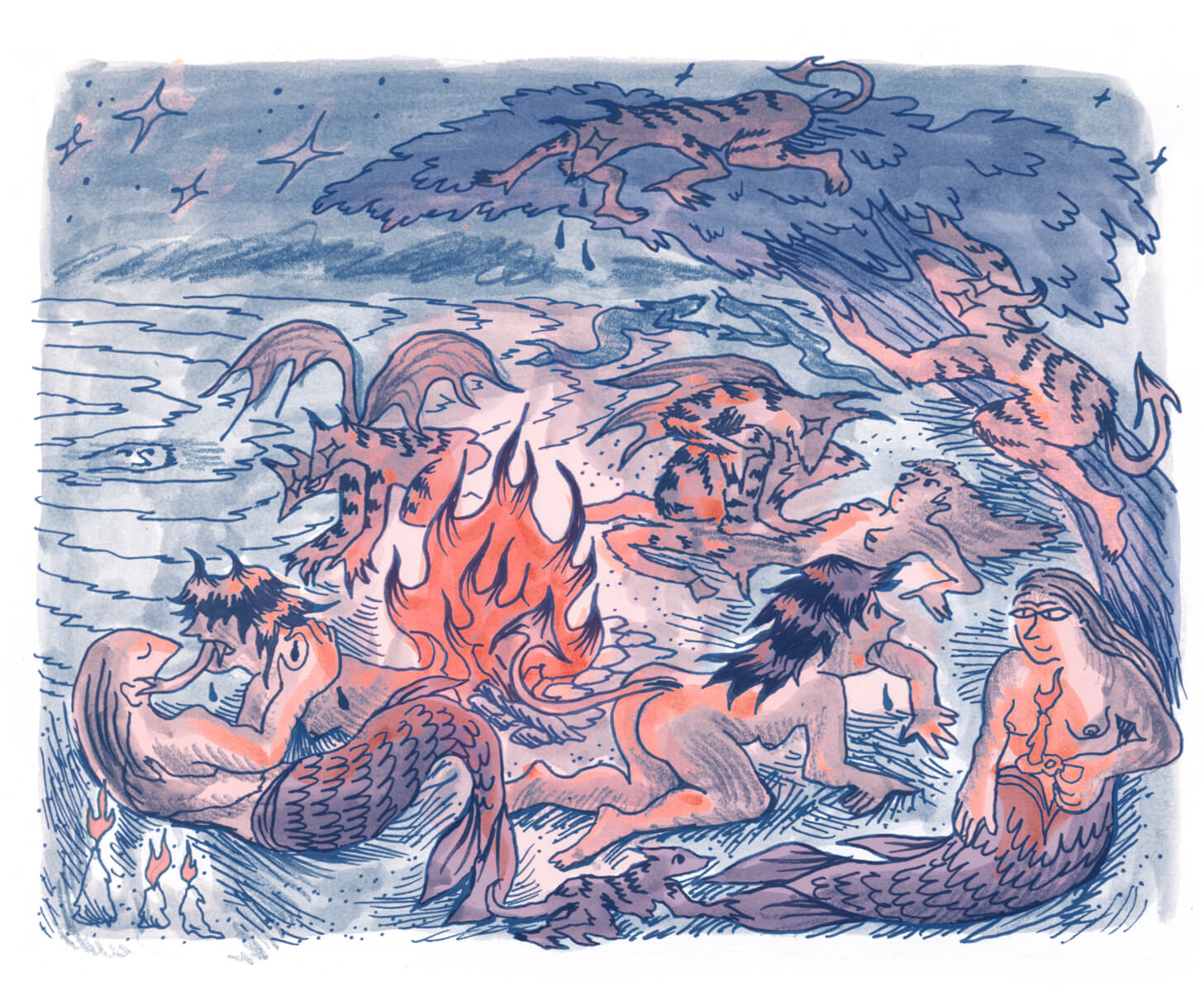
The sex in this book would be impossible if Wittig were not theorizing that lesbianism is an impossibility made possible: Lovers turn each other inside out, flay each other, copulate with hairy and scaled creatures, devour each other’s ears and crunch the cochlear bones. She uses strict anatomical language to strip away flesh but also to strip heterosexual romance of its givenness, its “goes-without-saying.” Deconstructing the symbolic order is as theoretical as it is material, which is to say, what is done to bodies in this book is what must be done to language: vivisection and reassembly. If this sounds hopelessly theoretical to a nonacademic reader, think of it this way: Heterosexuality is the institution that makes meaning possible, that orders the world, the rule not meant to be questioned. But if you press on the givenness of heterosexuality even a little bit — what do you mean, you don’t want a husband? — everything else becomes illegible, and our mechanism for meaning-making (language) no longer mirrors the world back to us. American lesbian feminists, after Adrienne Rich, simplify this problem as “compulsory heterosexuality.”
To read Wittig seriously is to understand that yes, lesbians are not women.
Wittig is writing at the intersection of the Marxist tradition of ideology critique and the structuralist theorization of signification, which refuted a natural connection between signifier and signified. Both these schools of thought laid the groundwork for her understanding of how “woman” becomes codified and naturalized. Wittig’s innovation is to reject the underlying logic of heterosexuality, in which the relationship between “man” and “woman” goes unexamined. If mid-twentieth century French theory argued that there is no nature, only culture, Wittig finds that even those critiquing within culture still accept a certain kind of nature: the “‘that-goes-without-saying’ of the straight mind.” Wittig writes in “The Mark of Gender” (1985), “Gender is the enforcement of sex in language, working in the same way as the declaration of sex in civil status.” While French grammar requires gender disclosure every time you use an adjective or speak in the past tense, English speakers fly under the radar until they have to fill out paperwork, an inevitable state formality.
Which is to say: This book is extremely French. I’d wager that The Lesbian Body has more in common with Charles Baudelaire than with Simone de Beauvoir or even, for that matter, Violette Leduc. Which makes sense: Baudelaire, like Proust, obsessed over lesbians. For every Baudelaire poem where a flaneur has a missed connection on the boulevard, there’s another poem where a woman gets her belly slit open to get fucked in a new set of lips, and another where an off-gassing carrion inspires the speaker to profess their true love — similar acts transpire in The Lesbian Body. Baudelaire’s lesbians are “femmes damnées” who plunge into the deepest abyss; he was wrong about that being hell, but right about how deep is our love. In fact, Wittig credits Baudelaire with inventing the term lesbian and prefers his work to that of actual lesbians, like Colette, who wrote “the mildest kind of love … the association of two beings victimized by men.”
The characters of The Lesbian Body often take their stories from myth: lesbian Orphée and lesbian Euridyce, lesbian Ulyssea coming home to Ithaca with a crew of lesbians, who anoint themselves with perfume. Central is the story of Isis, who reassembles the body of her dead lover Osiris with her tears. Sappho is invoked, of course: “Glory to Sappho for as long as we shall live in this dark continent.” (The phrase comes from Freud, writing about adult female sexuality, by way of colonial “explorer” Henry Morton Stanley.) Lovers turn into mud, mingle their intestines, feel their flesh flayed down to the bone, which the lover then polishes. Amid the paragraph- to page-long erotic dismemberments are full-page, all-caps lists of every bit of liquid and viscera involved in the making of the lesbian body: “THE CYPRINE THE SPITTLE THE SALIVA THE SNOT THE SWEAT THE TEARS THE WAX THE URINE THE FECES THE EXCREMENTS THE BLOOD THE LYMPH THE JELLY THE WATER THE CHYLE THE CHYME THE HUMORS THE SECRETIONS THE PUS THE DISCHARGES,” reads the first iteration. It’s mostly gore, but there is also a lot of candlelit dancing by the beach.
Lovers turn each other inside out, flay each other, copulate with hairy and scaled creatures, devour each other’s ears and crunch the cochlear bones.
Why all the dismemberment? Because, as Wittig explains in her remarks on the text, “when the lovers of The Lesbian Body kill, they resuscitate.” She kills the category of woman to resuscitate her corpse into something more exquisite, excessive, capacious. So, too, does she remake language into a meaning-maker anew. And because our membership as lesbians in the feminist struggle, or in the left struggle, must be dismembered as well. TERFs and SWERFs, after all, do not deserve the F in their name; they might identify as feminists, but they fight in the war against sexist oppression on the side of the sexist oppressors. Maybe we should instead attribute the F to fascist.
But the stakes are not only the survival of the movement against the threat of fascist fantasies. Given the fascist obsession with the trans body, it is not enough for (allegedly) cis lesbians to merely be “allies” or to nobly note that our struggles are linked. To read Wittig seriously is to understand that yes, lesbians are not women, and to use our current parlance, a lesbian is never cis. As Preciado observes in his introduction: “We would be tempted to understand the Lesbian Body as a becoming-trans corporality, but this would only be possible if trans is understood as a verb, rather than a noun, as a project rather than an identity, not as a clinical notion related to gender dysphoria or as a desire to simply move to the opposite gender, but rather as an experimental journey designed to escape political subjection, a radical transversal project to which anybody ready to mutate is invited.” He adds his evidence of experience: “I am pretty sure about all this because I was, and still am, in many ways, a Lesbian Body. I am one of those who took Wittig at their word, one of those who, before and after testosterone, made myself an incomplete and yet living body with their language.”
Wittig demands we reckon with ourselves as assembled anatomy that needs a radical stripping apart, that needs to be remade as our bodies encounter other bodies, and that needs to be reassembled in a process without end. Arguing that a lesbian is not cis is not to say that lesbians are materially living the same experience or living under the same threats as trans people, though they may and could. Wittig did see lesbianism as a specific and coherent — if excessive — category, not a totally loosey-goosey slime fest. Divine, are you a lesbian? Yes, I have done everything.
As less of a gold star and more of a brass tack, I have at times demurred from identifying as a lesbian. For a long time, I preferred to be called a dyke, or a dyke of bisexual experience, if I wanted to get technical about it. I have said that I live a lesbian lifestyle. I’ve also had my share of agnosticism toward my identity as a woman. (The woman I love describes herself as a non-practicing woman.) I’ve wondered whether my hesitancy stems from internalized misogyny (possible), my dislike of exclusionary gestures (how noble), or my general ambivalence about rendering myself legible (how adolescent). Sometimes I wish I came out the gate waving the banner LES BIENS ALORS TOUT VA BIEN, and I always wish that I had known more (or any) lesbians when I was younger, or that I had tried harder to seek them out when I was out of the house. I’ve also identified more as a lesbian as I’ve had more lesbian friends with whom I can discuss how one could possibly know that one is a woman, whether there is some kind of quiz we could take, or some reading materials, perhaps, like the “Am I a Lesbian?” masterdoc. Perhaps I only know something about myself once I’ve lived it for some time, and as I’ve lived it, I’ve learned that being a lesbian is so much more capacious than anyone can tell you. Anyone, except for Monique Wittig.
Natalie Adler is an editor at Lux and the author of the novel Waiting on a Friend.
Here's why we publish
Feminist thought is increasingly banned from universities and marginalized in billionaire-owned media. We’re proud to publish it. While these institutions are firing feminists, we’re hiring them — as brave journalists, writers, and artists who challenge ideas about gender at every level.
If this matters to you, please support Lux today. Independent media depends on you.